Mathemateg: Posau a Gweithgareddau
Error
If you are seeing this message something went wrong.
Please return to our puzzle menu and select your activity there.
Arbrawf Rygbi
Fel arbrawf, gofynnodd Ffred i'r cefnogwyr rygbi ar ddiwedd dwy gêm wahanol am wirfoddolwyr i roi cynnig ar gic adlam. Roedd am weld a oedd bod ar gae'r tîm cartref o fantais. Dangosir y canlyniadau isod
Cefnogwyr Cartref
| Gêm | Nifer y Gwirfoddolwyr | Llwyddiant |
|---|---|---|
| Cyntaf | 100 | 40% |
| Ail | 50 | 10% |
Cefnogwyr Oddi Cartref
| Gêm | Nifer y Gwirfoddolwyr | Llwyddiant |
|---|---|---|
| Cyntaf | 50 | 44% |
| Ail | 100 | 12% |
Roedd Ffred yn hapus i gael ei brofi'n gywir, roedd y cefnogwyr ar gae'r tîm cartref yn well na'r cefnogwyr oddi cartref. Sut gall ef brofi hyn?
Bydd yn rhaid i chi weithio allan faint o gefnogwyr oedd yn llwyddiannus ar gyfer y cefnogwyr cartref a'r cefnogwyr oddi cartref.
Drwy edrych ar faint o bob grŵp cefnogwyr oedd yn llwyddiannus, gwelodd fod 45⁄150 (30%), o'r cefnogwyr cartref yn llwyddiannus, ac mai dim ond 34⁄150 (22.67%) o'r cefnogwyr oddi cartref oedd yn llwyddiannus.
Pos Einstein
Mae'n debyg fod y Albert Einstein wedi creu'r pos hwn pan oedd yn blentyn. Gellir goresgyn yr her yma trwy ddefnyddio rhesymeg yn unig.
Mae pum tŷ drws nesaf i'w gilydd, sydd wedi'u paentio'n bum gwahanol liw. Mae person o genedl wahanol yn byw ym mhob tŷ. Mae pum perchennog y tai yn yfed gwahanol fath o ddiod, yn chwarae math penodol o chwaraeon, ac yn cadw anifail anwes penodol. Nid oes gan yr un perchennog yr un anifail anwes, nac yn chwarae'r un math o chwaraeon, nac yn yfed yr un diod.
Pwy biau'r pysgodyn?
Bydd yn rhaid i chi ddefnyddio'r ffeithiau isod i ganfod yr ateb.
- Mae'r Prydeinwr yn byw yn y tŷ coch.
- Mae'r Swediad yn cadw cŵn yn anifeiliaid anwes.
- Mae'r Daniad yn yfed te.
- Mae'r tŷ gwyrdd ar y chwith i'r tŷ gwyn.
- Mae perchennog y tŷ gwyrdd yn yfed coffi.
- Mae'r person sy'n chwarae pêl-droed yn magu adar.
- Mae perchennog y tŷ melyn yn chwarae pêl fas.
- Mae'r dyn sy'n byw yn y tŷ canol yn yfed llaeth.
- Mae'r Norwyad yn byw yn y tŷ cyntaf.
- Mae'r dyn sy'n chwarae pêl foli yn byw drws nesaf i'r sawl sy'n cadw cathod.
- Mae'r dyn sy'n cadw'r ceffyl yn byw drws nesaf i'r dyn sy'n chwarae pêl fas.
- Mae'r perchennog sy'n chwarae tennis yn yfed cwrw.
- Mae'r Almaenwr yn chwarae hoci.
- Mae'r Norwyad yn byw drws nesaf i'r tŷ glas.
- Mae cymydog y dyn sy'n chwarae pêl foli yn yfed dŵr.
Bydd yn rhaid i chi ddefnyddio'r Grid Rhesymu (yn Saesneg). Os nad ydych yn gwybod sut i ddefnyddio grid rhesymu, gallwch wylio tiwtorial ar y wefan posau rhesymu hon.
| Tŷ 1 | Tŷ 2 | Tŷ 3 | Tŷ 4 | Tŷ 5 | |
|---|---|---|---|---|---|
| Cenedligrwydd | Norwyaidd | Danaidd | Prydeinig | Almaenaidd | Swedaidd |
| Lliw | melyn | glas | coch | gwyrdd | gwyn |
| Diod | dŵr | te | llaeth | coffi | cwrw |
| Chwaraeon | pêl fas | pêl foli | pêl droed | hoci | tenis |
| Anifail Anwes | cath | ceffyl | aderyn | pysgodyn | ci |
Felly, yr Almaenwr sy'n berchen ar y Pysgodyn
Beth ddaw nesaf?
1, 8, 27, 64, 125 ...
Beth yw'r ddau rif nesaf yn y dilyniant hwn?
Pa rif sy'n dod ar ôl 729?
Meddyliwch am gyfaint y ciwbiau
Rhifau ciwb neu 13, 23, 33, 43, 53...
1, 8, 27, 64, 125, 216, 343, 512, 729, 1000
Beth ddaw nesaf?
0, 1, 1, 2, 3, 5, 8 ...
Beth yw'r ddau rif nesaf yn y dilyniant hwn?
Pa rif sy'n dod ar ôl 55?
Mae'r dilyniant hwn yn cynnwys adio 2 rif at ei gilydd
Dyma'r gyfres Fibonacci (adiwch y rhifau olaf gyda'i gilydd er mwyn cael y rhif nesaf):
0, 1, 1, 2, 3, 5, 8, 13, 21, 34, 55, 89
Beth ddaw nesaf?
4, 9, 25, 49 ...
Beth yw'r ddau rif nesaf yn y dilyniant hwn?
Pa rif sy'n dod ar ôl 961?
Mae'n cynnwys sgwariau rhifau penodol
Sgwariau rhifau cysefin:
4, 9, 25, 49, 121, 169, 289, 361, 529, 841, 961, 1369
Pos Pris y Pitsa
Mae tri o bobl yn rhannu tŷ ac maent yn archebu pitsa. Pan gyrhaeddodd, gwnaeth y dyn dosbarthu pitsas godi £25 arnyn nhw amdano. Rhoddodd pob un o'r tri £10 iddo. Rhoddodd y dyn dosbarthu newid iddynt, sef pum darn £1. Gan nad oedden nhw'n gallu rhannu hynny'n gyfartal, fe gymerodd pawb un darn £1, gan roi'r £2 arall i'r dyn dosbarthu. Wedyn fe wnaethan nhw sylweddoli bod pob un ohonynt wedi talu £9 i gyd am y pitsa, sy'n golygu bod y cyfanswm wedi dod i £27 ac wedyn eu bod wedi rhoi tip, £2, i'r dyn dosbarthu, sy'n dod i £29 i gyd. I ble aeth y £1 arall?
Sawl gwaith maen nhw'n cynnwys y cildwrn wrth gyfrifo?
Fe wnaethant dalu £27 am y pitsa a'r tip. Yna fe gawsant newid o £3 gan wneud cyfanswm o £30. Mae eu rhesymu'n ddiffygiol am iddynt adio'r tip ddwywaith ond nid gwerth y newid.
Dylunio Pontydd/h2>
Dychmygwch ddwy bont sydd union yr un fath ond bod pob dimensiwn un o'r pontydd ddwywaith mor fawr â'r llall. Pa un o'r ddwy bont fyddai'n gryfach, neu ai'r un yw eu cryfder?
Os ydych chi'n dyblu'r dimensiynau, beth fydd yr effaith ar y màs?
Trwy luosi pob dimensiwn â dau rydych yn cynyddu'r màs x8. Byddai'r bont fwyaf, felly yn dymchwel o dan ei phwysau ei hun.
Ffracsiynau Syml?
Os ydych yn rhannu pedwar deg â hanner ac yn ychwanegu deg, beth yw'r ateb?
Dividing something by a half is the same as doubling it.
Remember: Division is done before addition.
(40 ÷ ½) + 10 = 90
Dim amser i'r ysgol
Eglurodd Ioan wrth ei dad na fyddai'n mynd i'r ysgol eto. Dywedodd ei fod wedi bod yn gwneud symiau ac nad oedd ganddo amser i fynd i'w ddosbarthiadau. Rhesymodd, "Rwy'n cysgu wyth awr y dydd ac mae hynny'n gyfanswm o 2,920 awr neu 122 diwrnod y flwyddyn. Mae cyfrif pob dydd Sadwrn a dydd Sul yn gyfanswm o 104 diwrnod y flwyddyn. Os ydw i'n neilltuo tair awr y dydd ar gyfer prydau bwyd, mae hynny'n 45 diwrnod y flwyddyn. Mae gwyliau'r haf yn 60 diwrnod ac os ydw i'n neilltuo dwy awr yn unig bob dydd ar gyfer teledu a hamdden, mae hynny'n ychwanegu 30 diwrnod arall. Os ydw i'n cyfrif yr holl ddyddiau hyn, mae'n dod i gyfanswm o 361 heb gynnwys y Nadolig, y Pasg a'r gwyliau eraill." Beth yw'r gwendid yn rhesymu Ioan?
Chwiliwch am ble mae amseroedd wedi cael eu cyfrif fwy nag unwaith.
Camgymeriad rhesymeg Ioan yw ei fod wedi cyfrif rhai gweithgareddau sawl gwaith. Ni wnaeth gymryd i ystyriaeth ei fod eisoes wedi cyfrif pob pryd bwyd, amser hamdden ac amser gwely ar gyfer penwythnosau a gwyliau'r haf cyn eu cyfrif yn ddiwrnodau llawn.
Nodyn Dirgel
Wrth glirio'r atig, daeth Glenwyn o hyd i grêt pren a chlo arno.
Cyfuniad o rifau oedd y clo a ddefnyddiwyd, ac roedd angen 4 digid i'w agor.
Roedd hen ddarn o bapur drylliog ar y clawr ac arno'r geiriau:
I bwy bynnag ddaw o hyd i'r blwch hwn.
Yr wyf i, Tobius Flint, wedi cloi fy nhrysor pennaf yn y blwch hwn. Dim ond y rhai sy'n gwybod blwyddyn fy ngeni fydd yn gallu ei agor.
Yn gywir
T.Flint
Mawrth 30ain 1964
(-3,4)(3,-4)(-3,2)(-1,-1)(2,2)(2,4)(1,-4)(-3,-4)(3,4)(-3,0)
(1,4)(2,-4)(-2,-2)(2,-2)(-3,1)(-1,4)(0,-4)(1,-2)(2,0)(-1,0)
(-2,4)(-1,-4)(-1,2)(3,2)(-1,1)(3,0)(-3,-2)(3,-2)(1,0)(-2,2)
(0,4)(-2,-4)(-2,2)(1,2)(-3-1)(-1,-2)
(3,1)(1,-1)(-2,0)
Beth yw'r rhif pedwar digid sy'n angenrheidiol ar gyfer agor y clo?
Defnyddiwch bapur sgwariau ac, yn hytrach na phlotio'r cyfesurynnau ar fertigau, ceisiwch liwio'r sgwariau i mewn er mwyn cael darlun cliriach.
Trwy blotio'r cyfesurynnau mewn sgwariau a'u lliwio yn unol â'r nodyn, dylai fod gennych:

Gallai'r rhif hwn un ai fod yn oed y dyn neu ddau ddigid olaf ei ddyddiad geni. Trwy ddefnyddio'r dyddiad ar y llythyr, bydd y ddau ddull yn rhoi'r ateb i chi: 1882.
Cyfuniadau Ffasiynol
Caiff crys ffasiynol ei gynhyrchu mewn fersiynau i oedolion a phlant mewn 3 maint gwahanol (bach, canolig a mawr), mewn 10 lliw gwahanol ac mae ganddo 3 o ategolion gwahanol.
Nid yw'r ategolion yn angenrheidiol ond gellir eu defnyddio gyda'i gilydd mewn unrhyw gyfuniad.
Faint o wahanol ddewisiadau o grys ac ategolion sydd ar gael?
Y nifer o gyfuniadau o ategolion yw 8 (dim ategolyn, un ategolyn (3 opsiwn), dau ategolyn (3 chyfuniad) a'r ategolion i gyd)
Dewiswch un ai oedolyn neu blentyn (2 ddewis)
Dewiswch faint (3 dewis)
Dewiswch liw (10 dewis)
Dewiswch ategolion (8 dewis) (dim, un o dri, dau o dri, neu'r tri)
Felly, cyfanswm y cyfuniadau yw = 2 x 3 x 10 x 8 = 480.
Her y Crocodeil
Daw'r broblem fathemateg hon o Arholiad Uwch yr Alban gan Awdurdod Cymwysterau'r Alban (2015, Papur 2, Cwestiwn 8).
Mae crocodeil yn hela ysglyfaeth sydd 20 metr i fyny'r afon ar lan arall afon.
Mae crocodeilod yn teithio ar wahanol gyflymdra ar dir ac yn y dŵr.
Gellir lleihau'r amser mae'n ei gymryd i'r crocodeil gyrraedd ei ysglyfaeth os yw'n nofio at fan penodol, P, x metrau i fyny'r afon ar ochr arall yr afon fel sy'n cael ei ddangos yn y diagram.
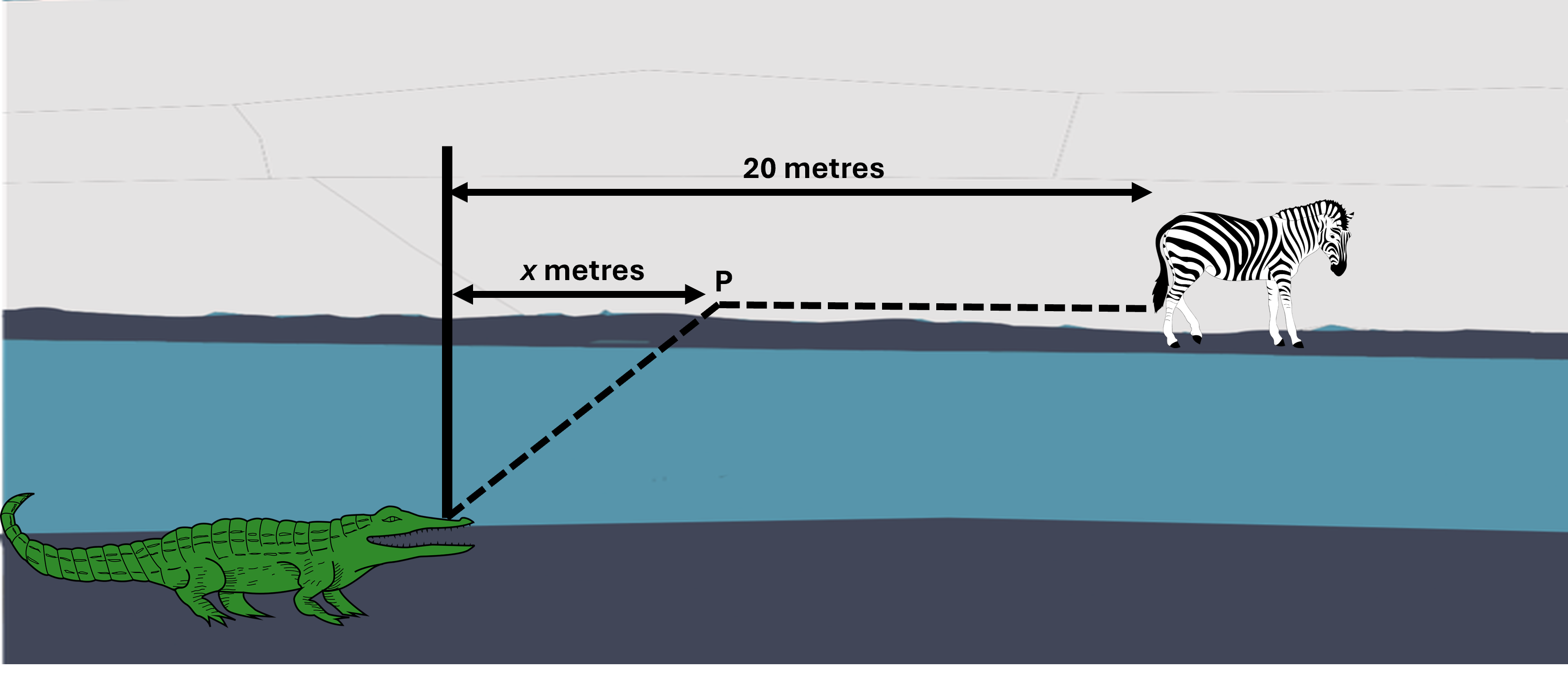
Mae'r amser mae'n ei gymryd, T, yn cael ei fesur mewn degfed ran o eiliad, ac yn cael ei roi trwy
\[T(x) = 5\sqrt{36 + x^2} + 4(20 - x)\]
- Gyfrifo'r amser a gymerir os nad yw'r crocodeil yn teithio ar y tir.
- Cyfrifo'r amser a gymerir os yw'r crocodeil yn nofio'r pellter byrraf posibl.
- Rhwng y ddau eithaf hyn, ceir un gwerth o x sy'n lleihau'r amser a gymerir. Canfyddwch werth x gan felly gyfrifo'r amser lleiaf posibl.
Mae'r hafaliad yn rhoi lled yr afon i chi, chwiliwch am hafaliad Pythagoras.
- 10.4 eiliad
- 11 eiliad
- x = 8, so T = 9.8 eiliad
Ysgrifennu Rhifau
Os yw saith mil, saith cant a saith o bunnoedd yn cael ei ysgrifennu fel £7,707, sut byddai un deg tri mil, un deg tri cant ac un deg tri punt yn cael ei ysgrifennu?
The thirteen hundred prevents us from repeating the same number writing pattern.
The correct approach: Thirteen thousand + thirteen hundred + thirteen
The answer: 13,000 + 1,300 + 13 = 14,313
Pos Pen-blwydd
Echdoe roedd Jasmin yn naw mlwydd oed. Y flwyddyn nesaf mi fydd hi'n ddeuddeg oed. Sut mae hynny'n bosib?
Dim ond os yw ei phen-blwydd yn digwydd ar ddiwrnod penodol o'r flwyddyn y gall hyn fod yn wir.
Mae'n Ionawr 1af ac mae pen-blwydd Jasmin ar Ragfyr 31ain. Mae hyn yn golygu ei bod hi'n 9 oed ar Ragfyr 30ain, 10 oed ar Ragfyr 31ain, mi fydd yn un ar ddeg oed ddiwedd eleni ac yna'n ddeuddeg oed ddiwedd y flwyddyn nesaf.
Hecsadocw
Swdocw sy'n defnyddio'r system hecsadegol o 16 nod yw hwn (0,1,2,3,4,5,6,7,8,9,A,B,C,D,E,F).
Mae'r rheolau yr un peth â Swdocw arferol, ond mae nodau ychwanegol i'w cynnwys.
| 8 | C | E | 1 | 7 | 9 | ||||||||||
| 5 | 4 | 2 | 0 | 1 | |||||||||||
| 3 | C | 5 | 8 | 4 | B | ||||||||||
| 0 | D | 7 | 4 | E | 2 | C | 8 | ||||||||
| 6 | 0 | C | B | 7 | E | ||||||||||
| D | 3 | 4 | 0 | ||||||||||||
| B | A | F | 8 | 9 | 3 | 4 | C | ||||||||
| 1 | 0 | 2 | D | F | E | 6 | 5 | 8 | |||||||
| F | 3 | A | B | 1 | D | 0 | 9 | E | |||||||
| D | 6 | 9 | 7 | 0 | 4 | ||||||||||
| 1 | 9 | D | 2 | C | A | 6 | |||||||||
| 5 | 6 | A | 0 | F | D | 2 | |||||||||
| B | C | 4 | F | 1 | |||||||||||
| 7 | E | 5 | 2 | 0 | |||||||||||
| B | E | 5 | 3 | F | |||||||||||
| E | F | 6 | B | 9 | 4 |
Archwilio Planet X
Mae tîm o wyddonwyr yn awyddus i lanio crwydrwr ar blaned X, er mwyn archwilio a dogfennu ei harwyneb.
Mae'n cymryd 88 o ddyddiau'r Ddaear i'r blaned fynd o amgylch yr haul, a 176 o ddyddiau'r Ddaear i gylchdroi yn llawn ar ei hechel.
Bwriad gwyddonwyr yw defnyddio crwydrwr pŵer solar. Bydd angen iddynt ddiffodd y pŵer yn ystod y nos ar y blaned.
Bydd hyn yn golygu mai dim ond am 88 o ddyddiau'r Ddaear yn olynol y bydd y crwydrwr yn weithredol, cyn diffodd ei bŵer am 88 o ddyddiau'r Ddaear.
Mae ymchwilydd wedi awgrymu y gallai fod yn bosibl, gan fod y blaned mor fach (diamedr o 3,030 milltir) i'r crwydrwr ddal i fynd yn barhaus trwy deithio o amgylch y cyhydedd ar gyflymder cyson.
Byddai hyn yn golygu bod y crwydrwr yn aros mewn golau dydd a chael ei wefru gan yr haul trwy gydol y daith ac na fyddai angen ei ddiffodd.
Pa mor gyflym y byddai angen i'r crwydrwr deithio?
Buanedd = pellter ÷ amser
Y pellter yw cylchedd y blaned
Cylchedd = π x diamedr
Amser = 176 diwrnod Daear
buanedd = pellter (milltiroedd) ÷ time (oriau)
buanedd = (π x 3030) ÷ (176 x 24)
gan defnyddio π = 3.14
buanedd = 9514.2 ÷ 4224
buanedd = 2.25 mya (i 2 bwynt degol)
Pyllau Padlo
Ar gyfer pen-blwydd Tomos, mae'r teulu yn dadbacio eu dau bwll padlo.
Mae pwll padlo Tomos yn silindrog. Mae'n 60cm o ddyfnder ac mae ganddo ddiamedr o 1.8m.
Mae pwll padlo Steve yn giwboid 2m o led, 1.3m o hyd a 80cm o ddyfnder.
Os bydd Tomos yn llenwi ei bwll padlo yn llawn, a Steve yn llenwi ei un ef yn dri chwarter llawn, pa un sydd â'r mwyaf o ddŵr ac o faint?
Cyfrifir cyfaint silindr trwy ddefnyddio'r hafaliad:
cyfaint = (π x radiws2) x uchder
Cyfrifir cyfaint ciwboid trwy ddefnyddio'r un hafaliad:
cyfaint = lled x hyd x uchder
cyfaint silindr = (π x radiws2) x uchder
radiws = diamedr ÷ 2
cyfaint pwll padlo Tomos = (π x (0.9m)2) x 0.6m
cyfaint pwll padlo Tomos = (π x 0.81) x 0.6
os cymerwn π = 3.14
cyfaint pwll padlo Tomos = 1.53m3 (to 2 d.p)
cyfaint ciwboid = lled x hyd x uchder
uchder = 3⁄4 o 80cm = 60cm neu 0.6m
cyfaint pwll padlo Steve = 2m x 1.3m x 0.6m = 1.56m3
Mae tua 0.03m3 mwy o ddŵr ym mhwll padlo Steve nag yn un Tomos
Ras y Planedau
Pellter y Ddaear o'r haul yw 93 miliwn o filltiroedd
Yr enw a roddir ar y pellter hwnnw yw Uned Seryddol (AU - Astronomical Unit).
Dyma dabl o'r planedau sydd yng nghysawd yr haul. Mae'n dangos eu pellter o'r haul, a pha mor hir yw eu blynyddoedd nhw yn nhermau amser y Ddaear.
| Planed | Y pellter o'r Haul - Unedau Seryddol (AU) | Hyd y flwyddyn, yn nhermau amser y Ddaear |
|---|---|---|
| Mercher | 0.39 | 88 diwrnod |
| Gwener | 0.723 | 225 diwrnod |
| Y Ddaear | 1 | 365 diwrnod |
| Mawrth | 1.524 | 687 diwrnod |
| Iau | 5.203 | 11.86 o flynyddoedd |
| Sadwrn | 9.539 | 29.5 o flynyddoedd |
| Wranws | 19.18 | 84 o flynyddoedd |
| Neifion | 30.06 | 165 o flynyddoedd |
Gan ddefnyddio'r wybodaeth hon, gan gymryd bod pob orbit yn gylchol, pa blaned sy'n symud gyflymaf, a ph'un yw'r un fwyaf araf?
buanedd = pellter ÷ amser.
orbit/pellter = cylchedd = 2πr (lle mae r = pellter o'r haul)
Gan ddefnyddio π = 3.14 a blwyddyn = 365 diwrnod
pellter (mewn Unedau Seryddol (Astronomical Units) fesul diwrnod) = cylchedd ÷ amser mewn diwrnodau
Mercher yw'r blaned gyflymaf yn teithio 0.28 Uned Seryddol (AU) y diwrnod.
Ffracsiynau o Ffracsiynau
Beth yw gwerth hanner (1/2) o ddwy ran o dair (2/3) o dri chwarter (3/4) o bedair rhan o bump (4/5) o bum rhan o chwech (5/6) o chwe rhan o saith (6/7) o saith rhan o wyth (7/8) o wyth rhan o naw (8/9) o naw rhan o ddeg (9/10) o un fil?
Y gamp yw gweithio tuag at yn ôl drwy'r broblem hon, felly dechreuwch gyda 9/10 of 1000.
naw rhan o ddeg o 1000 = 900
wyth rhan o naw o 900 = 800
saith rhan o wyth o 800 = 700
chwe rhan o saith os 700 = 600
pum rhan o chwech o 600 = 500
pedair rhan o bump o 500 = 400
tri chwarter 400 = 300
dwy ran o dair o 300 = 200
hanner 200 = 100
Yr ateb yw 100
Ffactorio
Beth yw gwerthoed x ar gyfer pob un o'r rhai isod?
- 8x2 - x = 0
- 9x2 - 49 = 0
- x2 - 9x + 20 = 0
- x2 + 4x - 12 = 0
- 8x2 + 15 = 22x
- 20x2 = 9 + 31x
Enghreifftiau i weithio drwyddyn nhw:
Canfyddwch werthoedd x pan 3x2 - 2x = 0
Cam 1: Factoriwch
x(3x - 2) = 0
Cam 2: Datryswch
x = 0 neu x = 2/3
Noder: Mae'r dull hwn ond yn gweithio ar gyfer y fformat ax2 + bx = 0. Fel arall, gweler isod.
Canfyddwch werthoedd x pan 6x2 - 5x - 4 = 0
Cam 1: Factoriwch
(2x + 1)(3x - 4)
Cam 2: Datryswch
Un ai 2x + 1 = 0 neu 3x - 4 = 0
Felly, x = -1/2 neu x = 4/3
Noder: Os nad oedd hyn yn eich helpu, ewch i wefan Maths is Fun am diwtorial mwy manwl.
- 0 neu 1/8
- 7/3 neu -7/3
- 4 neu 5
- 2 neu -6
- 5/4 neu 3/2
- 9/5 neu -1/4